
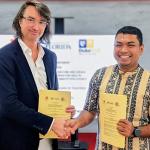
From left to right, Hendrik Luesch, Ph.D., a professor in the UF Department of Medicinal Chemistry and director of CNPD3, and Masteria Yunovilsa Putra, Ph.D., director of BRIN’s Research Center for Vaccines and Drugs, partner with Singapore’s Duke-NUS Medical School to translate Indonesia’s marine biodiversity into medicines and therapeutics.
Source: UF College of Pharmacy
Underneath the churning tides of the Indian and Pacific oceans lies a wealth of natural resources with the potential to heal what ails us.
A new global partnership among the University of Florida Center for Natural Products, Drug Discovery and Development, or CNPD3, Singapore’s Duke-NUS Medical School and Indonesia’s National Research and Innovation Agency, or BRIN, aims to translate the rich biodiversity of the waters surrounding Indonesia into medicines and therapeutic products for patients.
Hendrik Luesch, Ph.D., a professor in the UF Department of Medicinal Chemistry, the Debbie and Sylvia DeSantis Chair in Natural Products Drug Discovery and Development and director of CNPD3, said Indonesia is the perfect place to discover novel marine natural products because of its rich biodiversity with therapeutic potential.
“Indonesia consists of over 17,000 islands and is part of the Coral Triangle. This ‘Amazon of the sea’ harbors the greatest marine biodiversity on the planet,” Luesch said. “The genetic diversity of the region is expected to translate into chemical diversity and new pharmacology, representing an enormous, untapped resource for drug discovery.”
This international partnership enables UF’s CNPD3 and Duke-NUS to access the marine biodiversity of Indonesia and collaborate with the Indonesian government in researching and developing their marine natural products, from sample collection to chemical and pharmacological characterization to preclinical drug development. The venture serves as a global expansion of UF’s Blue Future Medicine Initiative, funded by a strategic, presidential investment. Luesch said this is the next, fundamental step in building global alliances in natural product drug discovery and cements UF’s leadership in the field.
“Trust is the glue for this trilateral collaboration. It’s a privilege to be chosen as the trusted partner of Indonesia. The stars were aligned this year. Singapore is admired in the region as a progressive leader with commitment to biomedical research, and this strategic partnership with BRIN is a direct result of my appointment at Duke-NUS, which created the gateway for new discoveries from unexplored marine biodiversity in Southeast Asia,” said Luesch, who serves as a professor in the program of cancer and stem cell biology at Duke-NUS Medical School. “I have fostered my relationship with Indonesia since 2013, when I visited the University of Indonesia and provided an award to a local rising star, Dr. Masteria Putra. In 2018, I hosted him as a Fulbright scholar in my UF lab, and he now serves as the director of BRIN’s Research Center for Vaccines and Drugs. Ultimately, the longstanding trust we formed provided the foundation for this partnership.”
Luesch’s emphasis on mutual trust and shared purpose is echoed by the other collaborators.
“This partnership reflects Indonesia’s commitment to advancing science through equitable and trusted global collaboration,” said Masteria Yunovilsa Putra, Ph.D., director of BRIN’s Research Center for Vaccines and Drugs. “Indonesia is not only a source of extraordinary marine biodiversity, but also a committed scientific partner with growing capacity in translational research. Through this collaboration with the University of Florida and Duke-NUS, we aim to ensure that discoveries originating from Indonesia’s marine resources are developed responsibly, scientifically and ultimately translated into tangible health benefits for patients worldwide.”
“For BRIN, this collaboration represents a strategic step toward strengthening Indonesia’s role in global drug discovery while building long-term scientific capacity and human capital,” Putra added. “Mutual trust, transparency and shared scientific vision are the foundations that allow such international partnerships to thrive.”
“This partnership builds on the joint appointment of Professor Hendrik Luesch and our shared commitment to translate biodiversity science into real therapeutic possibilities. By connecting Duke-NUS in Singapore with the University of Florida’s CNPD3 and Indonesia’s research ecosystem, it strengthens a trusted pathway from discovery to impact, anchored in rigorous science and long-term collaboration,” said Patrick Tan, M.D., Ph.D., dean and professor of the Duke-NUS Medical School.
Luesch said in an era marked by global tension, determination, creativity and synergy are important tools to maximize the impact of research and capabilities. “Oceans don’t know borders or political systems, but they connect all of us. In times of global division, we must not lose focus on what matters. We are all in the same boat but can make more progress when we are aligned. Collaborative science is based on trusting, priceless partnerships,” Luesch said. “We’re leveraging our complementary expertise, infrastructure and resources to hopefully trigger a new wave of medicine that benefits patients around the world.”