
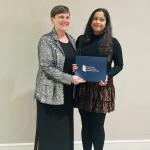
Sayantika Chakraborty receiving the Public Humanities Incubator award and Edward Guiliano Global Fellowship for her research, from the executive director of the Modern Language Association, Dr. Paula Krebs
Originally from India, Sayantika Chakraborty is a fifth-year PhD candidate in the English Department at the University of Florida, specializing in climate change narratives and environmental humanities. Her dissertation focuses on Indigenous women-led climate migration stories from India, blending personal investment, rigorous scholarship, and community engagement. Growing up hearing the experiences of her grandmother, a climate refugee, inspired her passion for amplifying the voices of women from the margins. Beyond her dissertation, Sayantika engages in public humanities projects, including a series of video documentaries documenting climate crisis stories from Indigenous women in India, which draws on extensive fieldwork conducted in the Summer of 2024.
At UF, Sayantika combines research, teaching, and community service to create a dynamic academic and public impact. She has designed and taught over ten courses, ranging from upper-division English classes to first-year composition, incorporating elements of climate crisis, indigeneity, and environmental non-fiction. Her leadership extends to mentorship and service, including roles with the International Mentorship Association’s Global Gator Connect Program, the International Center’s student council, and contributions to graduate admissions in the English Department. Through these efforts, she fosters equitable learning spaces while bringing attention to global climate challenges and migration stories often overlooked in mainstream discourse.
Could you tell us a little about your home country and what inspired you to study at the University of Florida?
“I am from India, and my work is on climate change induced crisis stories from the global South. I applied to UF for a PhD because of the resources that I needed to pursue my doctoral work here. For example, my dissertation director, Prof. Sidney Dobrin is a well-known name in the environmental humanities research, my primary field. Alongside, my other committee member, Prof. Terry Harpold, have been spearheading the “Imagining Climate Change” initiative at UF, that works towards a collaborative climate future in the times of planetary crises. Apart from the academic reasons, Florida weather was an important decisive factor as I cannot survive in a very cold weather.”
What was your academic or professional journey before coming to UF?
“I completed my undergraduate and master’s degree in English. Following which, I worked as an assistant professor of English at St. Paul’s Cathedral Mission college in India. Additionally, I was involved in community focused works with various not for profits in India that worked with female victims of climactic disasters such as cyclone and floods.”
Tell us about your professional background and how it relates to what you’re studying now.
“By profession, I am a teacher, and my pedagogy is largely informed by my research and community work. Back home, I taught courses on postcolonial and feminist literature, with a focus on minority voices. At UF, I have expanded upon this by designing and teaching more than ten courses, including upper division for the English major, special topics as well technical writing and first year composition courses. Aligned with the thematic scope and aim of these courses, I always make sure to incorporate elements related to my research on climate crisis and indigeneity in one form or the other, reflective of my current research. For example, in my recent upper-division course “Environmental Non-Fiction” (offered in Summer 2025), my students came up with an understanding of environmental crisis by studying and analyzing podcasts, documentaries, environmental policies both from the global North and South.”

Sayantika Chakraborty conducting research with climate migrants in India's Sundarbans- world's largest mangrove forest- in Summer 2024
Are you involved in any volunteer work, clubs, or organizations on campus or in the Gainesville community?
“In the Spring of 2023, I was selected as an IMA (International Mentorship Association) mentor in the Global Gator Connect Program, in partnership with UF’s International Admissions and have recently been elected to serve as a member in the International Center’s student council. Additionally, I help English Department during the graduate admission cycle by discussing admission offers with candidates who have been selected Outside UF, my work has been recognized by the Lynx Bookstore in Gainesville, and I delivered an invited lecture on my research as a part of the prestigious ‘Gainesville Reads’ event this Fall.”
What are your goals after graduation?
"I love to teach and through teaching, I feel that I can inspire my students to go beyond the traditional meaning and interpretation of a text and see it from a multi-disciplinary perspective. After graduation, I would like to stay in the US for a few years, hopefully teaching at a higher ed institution, but eventually plan to go back to India.”
How do you envision using your education and experiences at UF to make a positive impact in your field or community?
“I would say the amount of exposure that I got. UF has a solid international student population, and I got to know people from all walks of life and learned about their stories, reflective of richness and diversity. This is what my research is focused on- the stories that people from different backgrounds tell. And with all the experience and exposure that I received for five years at UF will help me move forward with my goal of serving communities through my research, more confidently.”
In what ways do you feel your presence has contributed to the UF community?
“My research is on the oft-obscured climate crisis and migration stories from India/the global South, and I am hopeful that by bringing attention to these stories through my research, teaching and community work, I have been able to not only amplify the voices of Indigenous women both locally and globally but also put forth the unexplored aspect of climate crisis on a global level, to the UF community.”
Do you have any advice or insights you’d like to share with other international students who are considering studying at UF?
“Speaking from my experience, sometimes international students are a bit shy to ask for help/advice. As a Global Gator mentor, I mentored an undergrad student from Germany and he and many other international folks that I have met, would sometimes be embarrassed to reach out for help. I would suggest trying to overcome that barrier and UF International Center can be a good place to start, as people here are always willing to help.”
What has been the most rewarding part of your experience at UF so far?
“Being able to work on my dissertation and seeing it taking the desired shape. I would not have been able to do it without the amazing support I received from my professors and colleagues in the English Department. I am particularly grateful to my dissertation director Prof. Sid Dobrin and my committee members, Professors Terry Harpold, and Raul Sanchez. A special mention should also be made for the UF Center for the Humanities and the Public Sphere as they strongly supported my work. For instance, I was awarded their Tedder Doctoral Fellowship, without which I would have been unable to do my field work in India.”