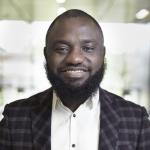
Abdulfatai Faro is a graduate student from Nigeria whose academic path has been shaped by a strong foundation in Chemical Engineering and meaningful international experiences. After completing his undergraduate studies in Nigeria, he continued to Lancaster University in the UK, gaining exposure to global research environments and firsthand insight into the challenges international students face. These experiences influenced both his professional goals and his passion for supporting others in academic transitions.
At the University of Florida, Abdulfatai conducts research in Chemical Engineering with a focus on semiconductor processes and device simulations. His work bridges materials behavior, computational modeling, and next-generation electronic device design. Outside the lab, he contributes significantly to UF’s graduate community through leadership roles, mentorship, and service work that reflects his commitment to both academic excellence and building supportive communities.

Could you tell us a little about your home country and what inspired you to study at UF?
"I am originally from Nigeria, a country known for its cultural diversity, strong community values, and deep commitment to education. Growing up there shaped my work ethic and motivated me to pursue engineering from an early stage. The University of Florida stood out for its strong engineering programs, interdisciplinary research opportunities, and welcoming atmosphere for international students."
What was your academic or professional journey before coming to UF?
"I completed my undergraduate degree in Chemical Engineering in Nigeria, where I graduated in the top tier of my class. I pursued further studies at Lancaster University, which gave me valuable international exposure. Professionally, I worked as a Subsea and Flow Assurance Engineer at FEDDO Group. These combined experiences ultimately prepared me for the level of research and collaboration I sought."
What are you studying here at UF, and why did you choose this field?
"I am studying Chemical Engineering, and my research focuses on semiconductor processes, particularly the fabrication and simulation of devices such as HEMTs and MOSFETs. I chose this field because it represents the perfect intersection of my interests in materials, transport phenomena, computational modelling, and energy-relevant technologies."
How does your current academic work tie into your previous studies or experiences?
"My current academic work ties very naturally into my previous studies. I built a strong foundation in transport phenomena, materials behavior, and numerical methods… Professionally, working as a Subsea and Flow Assurance Engineer reinforced my ability to analyze complex systems."

Are there any research projects you’re particularly passionate about?
"Yes, I’m currently working on a TCAD-based co-optimization of gate recess depth and gate length for threshold voltage in AlGaN/GaN HEMTs. It’s exciting to work on a project that contributes to future semiconductor technologies with real-world impact."
Tell us about your professional background and how it relates to what you’re studying now.
"My professional background is in Subsea and Flow Assurance Engineering… That experience strengthened my ability to analyze complex systems and use simulation tools to predict performance."
Have you worked on impactful projects that influenced your decision to come to UF?
"Yes. I worked on a carbon-capture and wastewater treatment project in Nigeria. At Lancaster University, I worked on a CFD-based design of a bladeless wind turbine. These experiences motivated me to come to UF."
Are you involved in volunteer work or organizations at UF?
"Yes, I serve as the Treasurer of the Engineering Graduate Student Council… I also mentor incoming PhD students and participate in graduate student recruitment. Outside UF, I volunteer with the City of Gainesville and mentor young people through Django Girls and Rubies Technologies."
How has your involvement enriched your UF experience?
"My involvement has made my UF experience much richer. These roles have made UF feel like home."
What are your goals after graduation?
"My goal is to continue working in areas that combine semiconductor process engineering, device simulation, and advanced materials. I’m open to opportunities in the U.S. and internationally, especially where I can make a meaningful impact."

How do you hope to use your UF education to make a positive impact?
"I plan to use my education to advance semiconductor technology. I hope to continue supporting students—especially international and underrepresented groups."
In what ways have you contributed to the UF community?
"I help support programming and events through the Engineering Graduate Student Council. As a mentor, I’ve supported many new PhD students. My volunteer work shows my commitment to connecting UF with the broader community."
Do you have any advice for international students considering UF?
"Embrace the community as early as possible. Ask questions, use available resources, and don’t be afraid to bring your unique background and culture into the UF community."
What has been the most rewarding part of your UF experience?
"The most rewarding part has been the opportunity to support others while growing myself. That balance of community and professional development has been the highlight of my time at UF."
What challenges have you faced as an international student, and how did you overcome them?
"One of the biggest challenges was adjusting to a new academic and cultural environment. Building a support system through mentoring programs and student organizations helped me feel at home."